RT Power Streamer
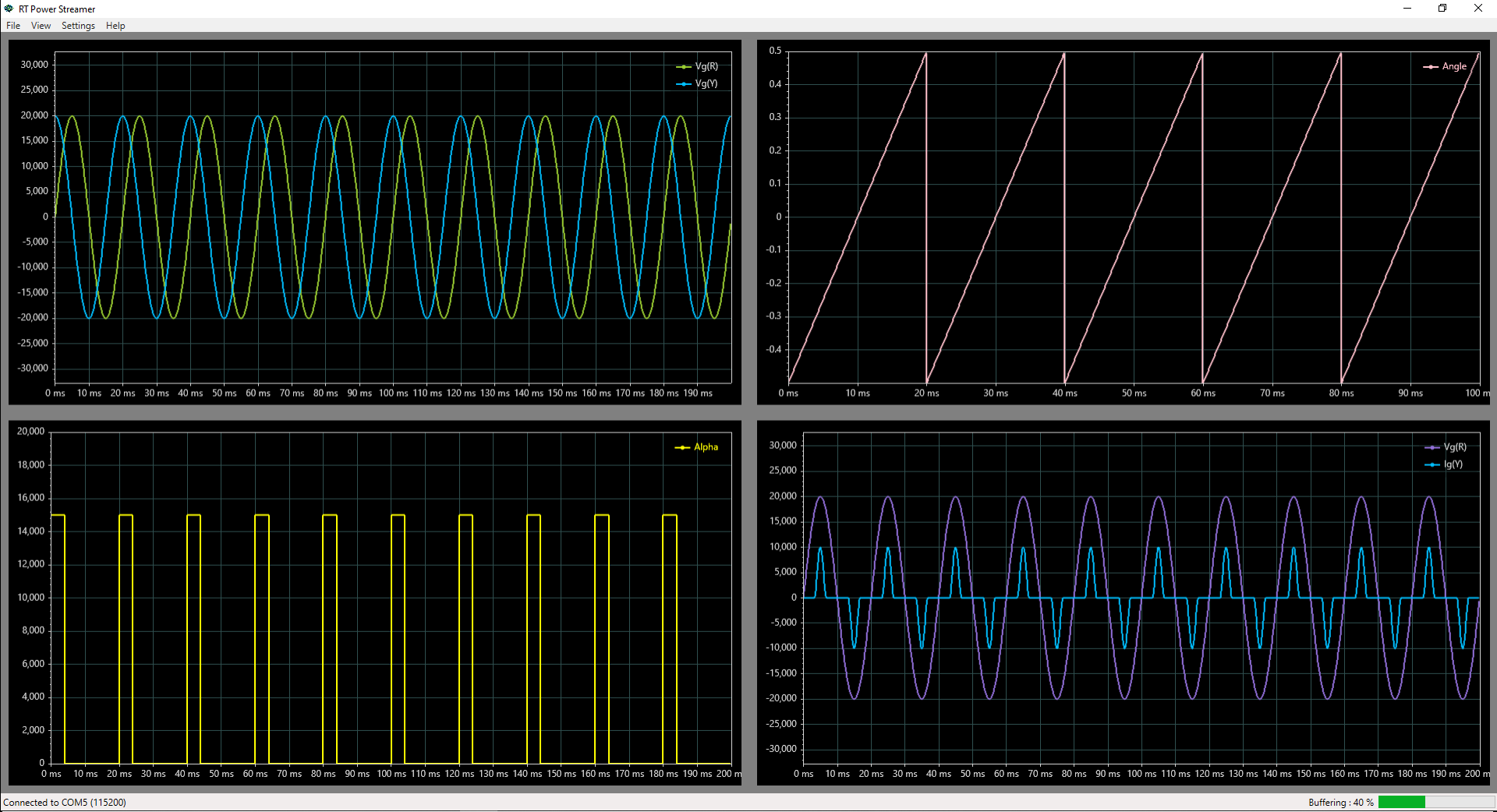
RT Power Streamer is a real-time data visualization and monitoring platform developed for power electronics, embedded control, and energy system applications. It provides engineers with a flexible framework to observe, analyze, and debug live signals streamed directly from embedded targets.
The platform is designed to visualize time-critical signals such as grid voltages, phase currents, electrical angle, control references, and internal state variables with minimal latency. A dark-themed user interface and optimized rendering pipeline make it suitable for long debugging and validation sessions.
RT Power Streamer follows a modular architecture where visualization layouts, signal groups, and processing logic can be configured based on application requirements. Rather than a fixed one-size-fits-all tool, the software acts as a reusable platform that can be adapted across multiple projects.
Core Capabilities
- Real-time waveform plotting with configurable refresh rates
- Multi-channel, time-synchronized signal visualization
- Support for voltage, current, angle, and control signals
- Dark-theme UI optimized for engineering workflows
- Low-latency streaming with buffered acquisition
Data Acquisition & Buffering Architecture
RT Power Streamer uses a target-centric data acquisition architecture. Signal sampling and buffering are performed directly within the target device memory, enabling deterministic data capture and reducing dependency on host-side timing.
The size and organization of the target-side data buffer are configurable based on sampling rate, number of signals, and available memory resources. This ensures stable streaming behavior even during high-throughput or burst-data scenarios.
By decoupling real-time acquisition from host-side visualization, the platform maintains consistent performance while allowing the PC application to focus on rendering, analysis, and user interaction.
Supported Communication Interfaces
RT Power Streamer supports integration with a wide range of communication interfaces commonly used in embedded and power electronics systems. The communication layer can be selected and configured based on target hardware capabilities and system requirements.
- Serial interfaces (UART / COM port)
- USB (Human Interface Device – HID)
- CAN and CAN-FD
- Ethernet (TCP / UDP based streaming)
- FlexRay
Interface availability and buffer configuration depend on target platform capabilities and project requirements.
Configurable & Optional Features
- Multi-panel dashboard layouts
- PLL and electrical angle visualization
- Event, gate, and timing signal plots
- Synchronized cursors and markers across plots
- Application-specific signal decoding
- Data logging and export
Typical Applications
- Grid-connected inverter development
- Motor drive control debugging
- Power converter validation
- Embedded firmware tuning
- Laboratory and production test setups
Customization & Integration
RT Power Streamer is designed to be customized to match specific project requirements. Visualization layouts, communication protocols, and signal processing logic can be adapted based on the target hardware and application domain.
Typical customizations include application-specific dashboards, protocol integration, signal decoding, and UI adaptations for domain-focused workflows.
Request Quote